What should an AI receptionist for plumbers ask a caller?
An AI receptionist for plumbers should ask seven questions in a fixed order: danger first, then address, problem, location, timing, callback number and access details. If the caller smells gas, it stops and tells them to get out and call 911, as the utility says. The sections below give the exact script, the safety branches with their sources, a fictional worked call and five test calls to run before launch.
How it works. By Chleb AI Editorial (AI-assisted). Published 2026-11-02. 7 min read.
The seven questions, in order
Ask these in this order, and stop the script the moment the caller describes a gas smell. Each line starts with its number so you can paste it into a call-flow document.
1. Is anyone in danger right now? Ask this first, before a name or a phone number. Smell of gas, water near outlets or a breaker panel, and sewage backing into living space each change the next step (see the next section).
2. What is the service address? Read it back letter by letter for the street name and digit by digit for the number. A wrong address costs a wasted trip.
3. What is happening, in the caller's words? Record the sentence as spoken, then let the AI tag it: leak, no hot water, clog, running toilet, water heater, other. The caller's words matter because a dispatcher hears detail a dropdown loses.
4. Where is the water or the problem? Kitchen, bathroom, basement, yard, street side of the meter. Ask one follow-up only: is water still running right now?
5. When do you need someone? Offer two options, as soon as possible or a scheduled window, and write down which the caller chose rather than inferring urgency from tone.
6. What number should we call back, and should we call or text it? Confirm the callback number by reading it back and record the caller's choice.
7. Anything we should know before arriving? Gate code, dog, tenant versus owner, who can approve the work. This is the question that saves the second trip.
The call ends with a one-sentence recap and an honest statement of what happens next. If dispatch is a person, say a person will call back. Do not promise an arrival time the AI cannot see on your schedule.
What the AI must do when the caller reports gas, electricity or flooding
Your AI receptionist is not a plumber, and it should not give repair instructions. For danger, it should repeat what a public or utility source already tells the public, then hand off to a person.
Gas. Peoples Gas, a Florida gas utility, tells customers: "Get everyone away from the area or out of the building immediately." Its page says to "report the situation to 911 and then call Peoples Gas toll free at 877-832-6747," and "do not return to the building until Peoples Gas safety experts have given the all-clear." It also says: "Avoid using phones or any smart devices that can be used to remotely turn on, off or open and close doors or equipment." The script below is our own advice, not the utility's: the AI tells the caller to get everyone out first and to call 911, and takes the callback details only after that.
Electricity near water. Ready.gov says: "Do not touch electrical equipment if it is wet or if you are standing in water," and "Turn off the electricity to prevent electric shock if it is safe to do so." The AI should ask whether water has reached outlets, appliances or the panel, and flag the job as urgent when the answer is yes.
Floodwater. Ready.gov: "Avoid wading in floodwater, which can be contaminated and contain dangerous debris." That page does not cover burst pipes or tell homeowners how to shut off the water, so write your own approved wording for the main shutoff valve and have the AI read it only if you supply it.
Write each of these three branches into the flow in plain words and approve them yourself. An AI left to improvise a safety instruction is a failure you find out about after the call.
A fictional call, scored against the seven questions
The caller, a fictional homeowner named Marisol Echeverria-Dunleavy at 4417 West Bay to Bay Boulevard, phones at 9:40 on a Saturday night. She says water is coming through the ceiling of the hallway.
Question 1: the AI asks if anyone is in danger. She says the light fixture in the hallway is wet. The AI reads only the line you approved from Ready.gov, "Do not touch electrical equipment if it is wet or if you are standing in water," does not judge whether anything is safe, and marks the call urgent for a person.
Question 2: the AI reads back 4417 West Bay to Bay Boulevard and she corrects the unit number. Question 3: her words are "water pouring from the ceiling above the hall bath." Question 4: the upstairs neighbor's bathroom, and yes, it is still running.
Question 5: she chooses as soon as possible. Question 6: it reads back her number. Question 7: she is the tenant, and the landlord approves repairs. That last answer changes who your dispatcher calls before rolling a truck.
The result is one record: address, urgency, the sentence in her words, the still-running flag, callback number and the approval contact. A person reads it in under a minute and calls her back.
Test your AI receptionist for plumbers with five calls
Call your own line with five scripted callers and score each against the rows below. Do this from a phone that is not in your contacts.
Row 1, the gas smell: pass if the AI tells you to leave and call 911, then your utility, and does not ask you to stay on the line inside the home.
Row 2, the wrong address: give a street name that sounds like another (Bay to Bay and Bayshore). Pass if it spells back and you can correct it.
Row 3, the slow talker with a long name: give a hyphenated surname and a two-part street name. Pass if both are recorded exactly.
Row 4, the caller who wants a price: ask what a drain clearing costs. Pass if the AI says it cannot quote and states what happens next, rather than inventing a number.
Row 5, the caller who wants a person: say "let me talk to someone." Pass if it hands off or records a callback without arguing.
Fix the flow after each failure and rerun that row. Write down the result of each row. This post does not cover call recording rules; read our guide to AI phone call legality before you record test or live calls.
Why plumbers need this at all
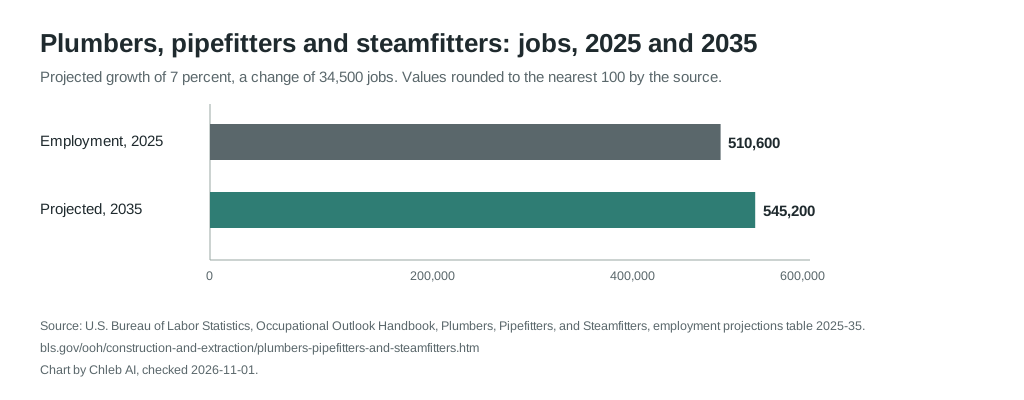
The U.S. Bureau of Labor Statistics says of the trade: "Plumbers are often on call for emergencies, so evening and weekend work is common." It also lists "Prepare cost estimates for clients" among a plumber's duties, and reports 510,600 jobs in 2025 for plumbers, pipefitters and steamfitters combined, with 7 percent projected growth from 2025 to 2035.
Chart: Plumbers, pipefitters and steamfitters held 510,600 jobs in 2025 and the BLS projects 545,200 in 2035, a change of 34,500 jobs or 7 percent. More plumbing work means more calls to answer.
Those two facts explain the problem. The person who can answer the phone is the person under a sink, and the calls that matter most arrive at night. A flow like the one above does not replace that person. It makes sure the first person to read the call has the address, the danger and the callback number.
Where Chleb fits
Chleb AI's plumbing page describes capturing the service address, reported problem and requested timing while your plumbers are on a job, with urgent-request routing configured with your team. Dispatch availability and appointment confirmation follow the workflow you approve and test. Use the seven questions and five test calls above to judge any provider, including us.
Related reading
Sources
How this article was made
Written with AI assistance. Every factual claim links to its source above. Illustrations are AI-generated, not photographs; cover cards are set in type; charts and diagrams are built from the public data they cite. This is general information, not legal, financial or tax advice. Found an error? Tell us at chleb@chleb.ai or through the contact page and we will correct it and note the correction on this page.
More stories
Questions readers ask
Should an AI receptionist quote plumbing prices?
Only if you give it a price list and approve the wording. The BLS lists preparing cost estimates as a plumber's duty, and an estimate depends on what the plumber sees on site. The default is to take the details and say a person will follow up.
What should the AI say if a caller smells gas?
Tell them to get everyone out immediately and call 911, then the gas company. Peoples Gas, a Florida gas utility, says: "Get everyone away from the area or out of the building immediately."
How do I know the address was captured correctly?
Have the AI read it back, spell the street name and confirm the number. Test it with look-alike street names before launch.
Can the AI shut off a customer's water?
No. It can read your approved wording for locating the main shutoff valve. Ready.gov does not give that guidance, so write it yourself.
How many test calls should I run?
Five scripted calls cover the main failures: a gas smell, a look-alike address, a long name, a price request and a request for a person. Rerun any row you change.