How Does Google Decide Which Local Business to Show?
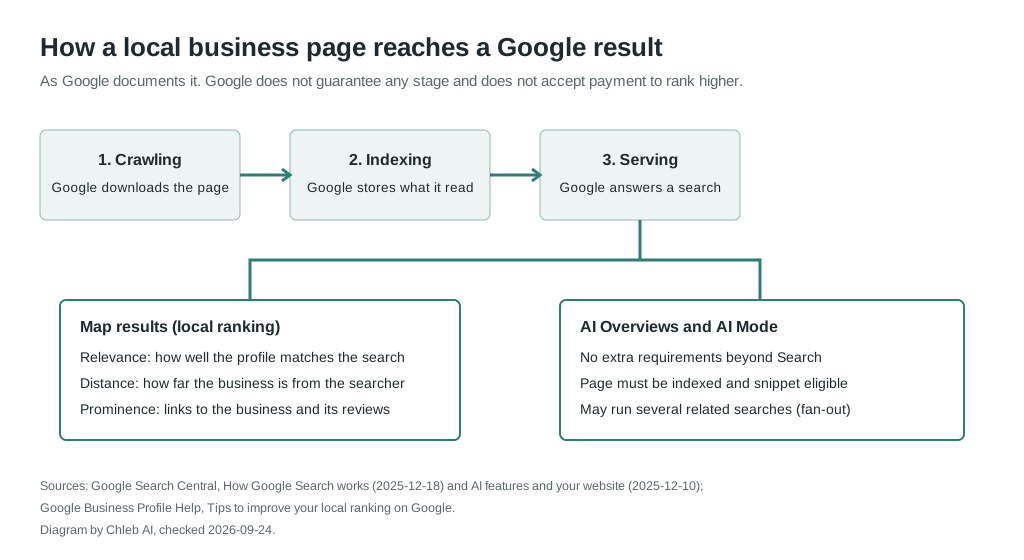
How does Google decide which local business to show when someone searches for a service near them? For the map results, Google says it weighs three things: relevance, distance and prominence. For its AI Overviews and AI Mode, Google says there are no extra requirements beyond ordinary Search: your page has to be crawled, indexed and eligible to show a snippet. Google also says it does not accept payment to rank a business higher. This guide explains each piece in plain terms, using Google's own documentation, and shows what an owner can and cannot change.
How it works. By Chleb AI Editorial (AI-assisted, reviewed). Published 2026-09-26. 7 min read.

First, Google has to find your page at all
Google describes Search as three stages. In crawling, automated programs download text, images and video from pages Google has found. In indexing, Google analyzes those files and stores what it learns in the Google index. In serving, Google returns information relevant to a person's query. A page that is never crawled cannot be indexed, and a page that is not indexed cannot be served, in regular results or in AI answers.
Two lines in that documentation matter for any owner deciding where to spend money. Google says it "doesn't guarantee that it will crawl, index, or serve your page" even when the page follows its guidelines. It also says it "doesn't accept payment to crawl a site more frequently, or rank it higher." Anyone who promises a guaranteed first-page ranking is promising something Google itself does not promise.
You can check the first two stages yourself. Google Search Console, which is free, has a URL Inspection tool that shows whether a page is on Google and the last time Google crawled it. If a service page you care about shows as never crawled, nothing else in this guide will help that page until that changes.
How does Google rank a business in the map results?
For local results, the list with the map that appears for searches like "AC repair near me," Google's Business Profile help center names three factors. Relevance is how well a Business Profile matches what someone is searching for. Distance is how far each business is from the customer who is searching. Prominence is how well known a business is.
Relevance is the factor an owner controls most directly. Our reading is that it depends on what your Business Profile actually says: the primary category, the services you list, your description and your hours. A plumbing company whose profile lists only a generic category and no services gives Google little to match against a search for water heater installation.
Distance you mostly cannot change, short of opening another real location. It is the reason a business can rank well for customers nearby and poorly across town on the same search.
Prominence is built over time. Google says it is based on information like how many websites link to your business and how many reviews you have, and that more reviews and positive ratings can help a business's local ranking.
How do AI Overviews and AI Mode choose which pages to use?
Google's guidance for site owners on its AI features is short and direct. It says there are "no additional requirements" to appear in AI Overviews or AI Mode, and no special optimizations needed. To be eligible as a supporting link, a page must be indexed and eligible to be shown in Google Search with a snippet. Google also says you do not need new machine-readable files, AI text files or special markup to appear.
The same page explains that AI Mode and AI Overviews may use a "query fan-out" technique, running several related searches across subtopics and data sources to build a response. In practice, a question like "who fixes air conditioners on weekends in Tampa" may be split into related searches about weekend service, pricing and service areas. A page that answers one of those questions plainly has more chances to be pulled in than a page that only says a business offers "quality service."
This is why question-shaped pages matter. A services page that states what you do, where, when and roughly what it costs gives the fan-out searches something concrete to match. We cover the same idea for ChatGPT and other assistants in our guide to getting recommended by ChatGPT.
Why some websites are harder for search engines to read
Many modern websites build their pages in the visitor's browser with JavaScript. Google says Googlebot queues pages that return a normal 200 status for rendering, so Google can usually see content that JavaScript adds. But its own guidance adds that server-side rendering or pre-rendering "is still a great idea" because it makes a site faster and because not all bots can run JavaScript.
That second point matters for AI search, because the crawlers behind some AI assistants may be among the bots that do not run JavaScript. If the words describing your services only appear after scripts run, some of those crawlers may see an almost empty page. Ask whoever built your site whether the full text of each service page is present in the HTML the server sends. A web developer can check that in a few minutes with a command-line fetch of the page.
Chleb AI's own site is built this way for that reason: each page is pre-rendered so its full text is in the served HTML.
Reviews help, but only real ones
Because reviews feed prominence, some owners are tempted to buy them or to write them. Both break rules that carry real consequences. Google's Maps contribution policy prohibits content "not based on a real experience" and reviews or ratings that were paid for, and it says merchants may not offer incentives such as payment, discounts or free services in exchange for posting a review.
Federal rules now cover this too. The Federal Trade Commission's rule on consumer reviews and testimonials, 16 CFR Part 465, addresses fake or false reviews, insider reviews, company-controlled review sites and review suppression. Section 465.4 makes it an unfair or deceptive practice to "provide compensation in exchange for consumer reviews expressing a particular sentiment," positive or negative.
The legitimate path is slower and it works with the rules instead of against them: ask every satisfied customer, make the review link easy to find, and reply to reviews, good and bad. Google's help center says replying to reviews shows customers you value their feedback.
What an owner can do this month
Check Search Console: confirm your homepage and each service page are crawled and indexed, and note any that are not.
Fix relevance in your Business Profile: choose the most specific primary category, list every service you actually offer, keep hours current, and describe your service area honestly.
Give each important question a plain answer on your website: what you do, where, when, and how pricing works. One clear page per service beats one page that lists everything.
Make sure the full text of each page is in the served HTML, not only added by scripts.
Ask every satisfied customer for a review, never pay for one, and reply to the reviews you get.
Chleb AI is an AI receptionist and website chatbot for service businesses, with CRM setup, based in Tampa, Florida. We also build service-business websites and do local SEO. Our Tampa SEO page and Tampa web design page explain how we set that work up.
Related reading
Sources
- Google Search Central, In-depth guide to how Google Search works (updated 2025-12-18), checked 2026-09-24
- Google Search Central, AI features and your website (updated 2025-12-10), checked 2026-09-24
- Google Business Profile Help, Tips to improve your local ranking on Google, checked 2026-09-24
- Google Search Central, Understand JavaScript SEO basics (updated 2026-03-04), checked 2026-09-24
- Google Maps User Contributed Content Policy, fake engagement, checked 2026-09-24
- 16 CFR Part 465, FTC Trade Regulation Rule on the Use of Consumer Reviews and Testimonials (Cornell LII), checked 2026-09-24
- 16 CFR 465.4, buying positive or negative consumer reviews (Cornell LII), checked 2026-09-24
- Google Search Console Help, URL Inspection tool, checked 2026-09-24
How this article was made
Written with AI assistance and reviewed by the Chleb AI team before publishing. Every factual claim links to its source above. Illustrations are AI-generated, not photographs; cover cards are set in type; charts and diagrams are built from the public data they cite. This is general information, not legal, financial or tax advice. Found an error? Tell us at chleb@chleb.ai or through the contact page and we will correct it and note the correction on this page.
More stories
Questions readers ask
Can I pay Google to rank my business higher?
No. Google says it does not accept payment to crawl a site more often or rank it higher, and its Business Profile help center says there is no way to request or pay for a better local ranking.
What are the three local ranking factors?
Google names relevance, how well a Business Profile matches the search; distance, how far the business is from the customer who is searching; and prominence, how well known the business is, which Google says draws on links to your business and your review count.
Do I need special markup or an AI text file to appear in AI Overviews?
Google says no. Its guidance states there are no additional requirements for AI Overviews or AI Mode beyond being indexed and eligible to show a snippet in Search, and that new machine-readable files, AI text files or special markup are not needed.
How do I know if Google has indexed my service pages?
Use Google Search Console, which is free. Its URL Inspection tool shows whether a page is on Google and the last time Google crawled it.
Is it legal to give customers a discount for leaving a review?
Offering an incentive for posting a review breaks Google's Maps contribution policy. Separately, the FTC rule at 16 CFR 465.4 prohibits paying for reviews that express a particular sentiment. Ask your attorney before running any review incentive.
Does a JavaScript website hurt my search visibility?
Google usually renders JavaScript, but it recommends server-side rendering or pre-rendering because not all bots can run JavaScript. If some AI crawlers cannot see your service text, those assistants have less to work with.